
Weight loss gets the headline. Hair shedding is what patients bring up quietly in the consultation — if they mention it at all. Increased hair shedding is among the most commonly reported concerns in aesthetic practice following GLP-1–related weight loss; a 2026 claims-based study reports high rates of hair shedding in GLP-1 patients and suggests a clinically relevant phenomenon, while emphasizing that further work is needed to establish precise prevalence.
Complicating the picture: a substantial share of GLP-1 patients in aesthetic practices are perimenopausal or menopausal women, a demographic already at higher likelihood of female pattern hair loss.
Emerging safety data has also identified a possible association between GLP-1 receptor agonist use and alopecia in some patients that may extend beyond weight-loss–related shedding — though current evidence frames this as an association under investigation, not an established causal pathway.
For providers seeing this patient population, understanding both hair loss patterns is increasingly relevant.
In this GLP-1 round up:
Telogen effluvium (TE) is a well-documented response to rapid physiologic stress, including significant weight loss. The hair follicle shifts prematurely into the resting and shedding phase, producing diffuse hair loss typically beginning two to four months after the triggering event.
In GLP-1 patients, commonly cited mechanisms include caloric restriction, micronutrient shortfalls affecting follicle health, and the physiologic stress of significant body composition change.
These are consistent with expert commentary and emerging clinical discussion — though they should be understood as likely mechanisms, not definitively established causal pathways.
A 2025 analysis by Burke et al. also identified an association between semaglutide use and alopecia in some patients that appeared independent of weight loss — present this to patients as an emerging finding under study, not a confirmed drug effect.
At SCALE 2026 (Nashville, May 2026), Dr. Terrence Keaney, MD outlined a three-phase aesthetic management framework for GLP-1 patients, with hair-loss prevention introduced in Phase 1 at drug initiation — alongside skin care and muscle preservation counseling.
He cited evidence that up to approximately 40% of weight lost on GLP-1 therapy may be lean mass, with downstream effects on body composition, aging appearance, and follicle vulnerability.
For GLP-1–associated shedding, Keaney recommended oral minoxidil as a practical early intervention, noting its systemic reach and compliance advantages over topical regimens.
Oral minoxidil is off-label for this indication and requires appropriate screening — providers should assess for cardiovascular disease, hypotension, and other contraindications before initiating.
In practice, hair shedding is often underreported unless clinicians ask directly. Many patients attribute it to the medication and don’t raise it as a primary concern, or they don’t connect it to the weight-loss process at all. Screening at drug initiation — not after significant shedding begins — gives providers the window to intervene early.
A substantial share of GLP-1 weight-loss patients in aesthetic practices are perimenopausal or menopausal women — a demographic at higher likelihood of female pattern hair loss (FPHL / androgenetic alopecia in women). When TE and FPHL co-occur, the combined presentation can look like a single, medication-related problem — and it’s easy to miss the underlying progressive condition.
The distinction matters clinically. TE typically self-limits within approximately three to six months after the trigger resolves; FPHL is progressive without intervention. Phenotypically, TE presents as diffuse shedding across the scalp.
FPHL in women presents with crown thinning and a preserved frontal hairline, and may also show as a widened midline part.
A patient with both patterns will need management for each — treating only the TE without addressing the underlying FPHL leaves the progressive condition unchecked.
At the 14th World Congress for Hair Research (Seoul, May 2026), Harth Y and Harth O presented an AI-enabled analysis of 187,016 menopausal women on the MDhair platform — the largest menopausal FPHL cohort reported to date. This is conference poster data (Abstract E-466, not yet peer-reviewed); all figures should be understood as poster-level findings as reported by Dermatology Times, not established population prevalence rates.
With that framing, the findings are clinically striking. In the cohort, 51% had moderate-to-severe thinning. Thyroid dysfunction was present in 19.4% — compared to approximately 10–14% in general U.S. women aged 45–64. GI symptoms were reported in 32.6%, versus approximately 10–15% in general population estimates. Family history was present in 26.6%, and its presence was strongly associated with severity: 61.3% of women with family history had moderate-to-severe thinning versus 45.8% without. Constant scalp itch was associated with a 2.2-fold higher rate of severe thinning. COVID-19 history was significantly associated with sudden shedding in the dataset.
As Dr. Harth stated in the Dermatology Times coverage: “Hair loss in menopausal women is not a single disease. It is the visible end of a broader inflammatory, endocrine, and gastrointestinal phenotype.”
The clinical implication is not that treating thyroid disease or GI symptoms will reverse hair loss — the data identifies associations, not proven treatment pathways.
What it does mean: thyroid history, GI symptoms, and scalp inflammation are clinically relevant in menopausal patients presenting with hair concerns, and may warrant referral to dermatology or trichology when systemic drivers are suspected.
Two categories of intervention apply to this patient population: medical options that address the biological trigger, and procedural options that stimulate follicle activity.
On the medical side, oral minoxidil — as recommended by Keaney for GLP-1–related TE — is the current first-line expert preference for early intervention, with the CV screening and off-label discussion noted above. Topical minoxidil is widely available OTC and useful for some patients but is limited by adherence and local absorption compared to the oral form.
When systemic drivers of FPHL are suspected, referral to dermatology or trichology for full workup is the appropriate step — aesthetic providers are well-positioned to identify the concern; trichologists and dermatologists are better positioned to investigate it.
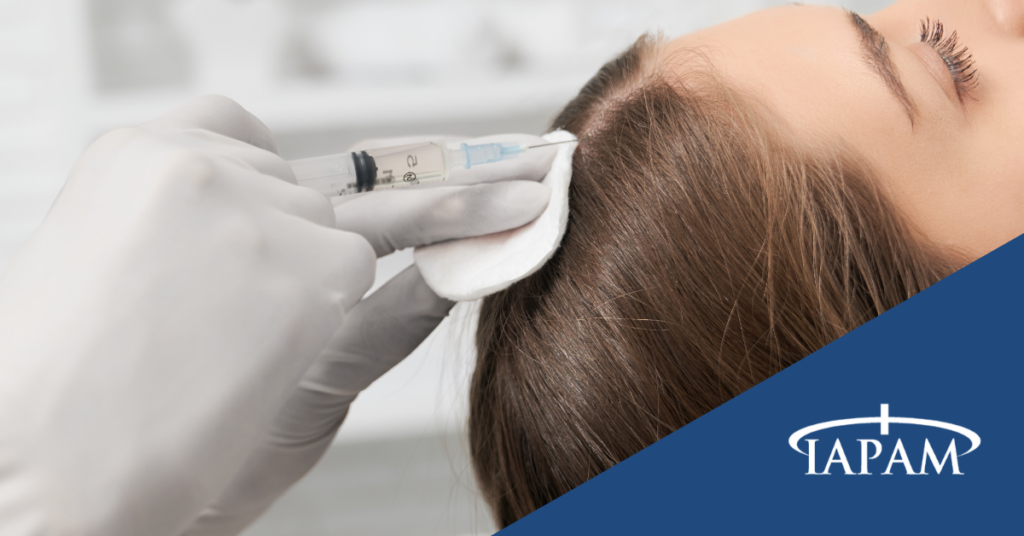
On the procedural side, PRP is supported by multiple randomized controlled trials and meta-analyses as an effective option for improving hair density in androgenetic alopecia, with moderate-quality evidence overall.
Protocol matters significantly — technique and concentration affect outcomes, and the literature notes meaningful heterogeneity across PRP protocols.
Low-level laser/light therapy (LLLT) is FDA-cleared for AGA and is supported as an adjunctive option in systematic reviews; it is best positioned as an adjunct, not a standalone treatment. Energy-based scalp devices are being explored but have limited published data for FPHL specifically — do not overstate the evidence base.
The simplest practice change is to add hair screening to the GLP-1 intake protocol. It takes less than two minutes, captures a concern most patients won’t raise unprompted, and opens a clinical conversation that frequently expands into a longer treatment relationship.
For providers building out weight management programs that address the full post-weight-loss patient, IAPAM’s Certified Medical Weight Management Provider program covers GLP-1 protocols and patient management across the weight-loss journey.
Providers adding procedural hair services — including PRP — can explore the Certified Aesthetic Provider program or the Facial Rejuvenation Certification, which includes PRP within a broader aesthetic treatment framework. A dedicated Hair Restoration course covering PRP for androgenetic alopecia is also in development at IAPAM.
Do GLP-1 medications cause hair loss?
Two mechanisms are relevant and distinct. First, rapid weight loss on GLP-1 therapy is a well-established trigger for telogen effluvium — the hair loss in this case is from the weight loss itself, not the medication directly.
Second, a 2025 analysis by Burke et al. identified an association between semaglutide use and alopecia in some patients that appeared independent of weight loss. This is an emerging finding under investigation — it frames semaglutide-associated alopecia as a possible direct effect in some patients, but does not establish causation. Both considerations belong in the patient conversation.
How long does hair loss last after GLP-1 weight loss?
Telogen effluvium related to weight loss typically self-limits within approximately three to six months after the trigger resolves — meaning once weight stabilizes and nutritional status normalizes. If underlying female pattern hair loss is also present, shedding may persist or worsen without intervention, since FPHL is progressive. Early identification of both conditions is the key to appropriate management timing.
What is telogen effluvium and is it the same as female pattern hair loss?
They are distinct conditions that can co-occur. Telogen effluvium is a diffuse, temporary shedding response to physiologic stress — including rapid weight loss, illness, or nutritional disruption. It typically resolves once the trigger is removed.
Female pattern hair loss (FPHL) is a progressive, androgenetic process that produces crown thinning and, in women, a widened midline part. FPHL does not self-resolve and requires ongoing management. A patient experiencing GLP-1–related weight loss who is also perimenopausal may have both simultaneously.
What can I do for patients experiencing hair shedding on GLP-1 medications?
Start by distinguishing TE from FPHL — the management differs. For GLP-1–related TE, Dr. Keaney’s recommendation per SCALE 2026 is early oral minoxidil, initiated at or shortly after drug start, before significant shedding occurs.
Screen for contraindications before initiating. If FPHL is suspected alongside TE, referral to dermatology or trichology for full workup is appropriate, particularly when systemic drivers (thyroid, GI, inflammatory) are part of the clinical picture. PRP is a procedural option with solid RCT evidence for AGA once the TE component has stabilized.
Is oral minoxidil appropriate for GLP-1-related hair loss?
It is the current expert preference for early intervention in GLP-1–associated telogen effluvium, based on Dr. Keaney’s recommendation at SCALE 2026. Oral minoxidil is off-label for this specific indication. Before initiating, assess for cardiovascular disease, hypotension, and other contraindications — oral minoxidil carries systemic effects that require medical oversight.
For FPHL, oral minoxidil also has evidence in the broader hair loss literature, though that is a separate clinical decision from TE management.
Does PRP work for hair loss in menopausal women?
The strongest evidence base for PRP in hair loss is for androgenetic alopecia broadly — which includes FPHL in women. Multiple RCTs and meta-analyses support PRP for improving hair density in AGA, with moderate-quality evidence overall. Protocol matters: concentration and technique affect outcomes, and not all PRP protocols produce equivalent results.
For menopausal patients where systemic drivers (thyroid, GI) may be contributing, addressing those factors with appropriate referrals alongside PRP is a more complete approach than PRP alone.
How do I tell if a patient has telogen effluvium vs. female pattern hair loss?
TE presents as diffuse shedding across the scalp, typically two to four months after a triggering event (weight loss, illness, nutritional stress). FPHL in women presents with crown thinning and a preserved frontal hairline, and may show as a widened midline part.
Timing relative to GLP-1 initiation and weight loss is a useful clinical marker — TE correlates with the physiologic stress event; FPHL progression is more gradual and typically predates the medication. Both can be present simultaneously, particularly in perimenopausal or menopausal patients.
Free Practice Resource
Request your free Quick Start Checklist for starting or integrating a new GLP-1 for weight loss in your practice.
✓A practical first step for providers evaluating GLP-1 weight-management services and their place in a broader patient-care offering.
Request Your Free Copy →
Click the guide image to request your free copy.
Want to add Botox® training to your practice plan? Explore IAPAM’s Botox training options →
Request your Quick Start Checklist for Starting or Integrating a New GLP-1 for Weight Loss Guide.
Terms and conditions apply. Offer expires October 31.